Back in the day, when I first got to Nepal in the late 1960s, there were, for all practical purposes, no roads in the hills of Nepal other than those that linked Kathmandu to India to the south and Tibet to the north. All movement was by foot, and all goods moved on people’s backs.
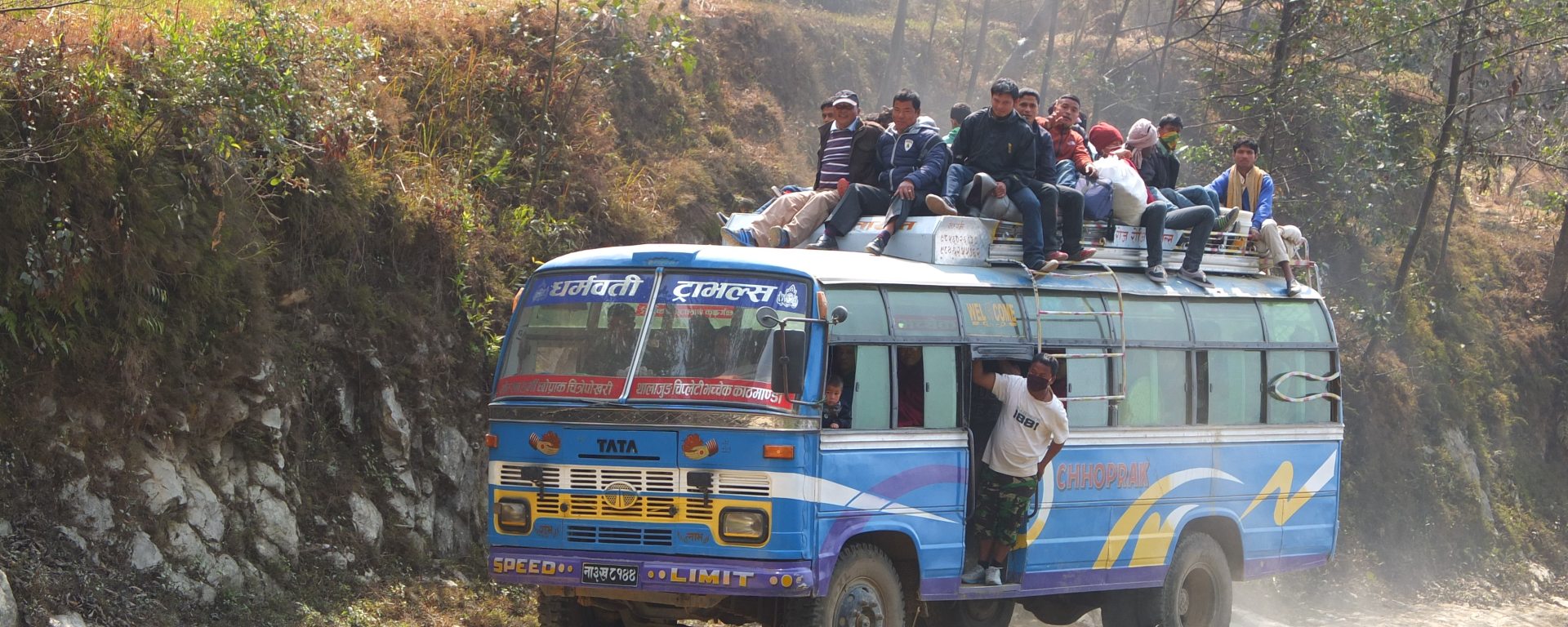
Now, from what I see in Gorkha District, there are roads going into the  most improbable, impossible places. They are not good roads – traveling on one by bus or jeep is a jolting, jarring, unpleasant experience. And terribly dusty.
At first I thought that local villages must have pooled their money, hired a bulldozer and punched in these roads that go where no road should go. I thought they got a road to a point where you could bring a 4WD tractor in to a village and then let it go at that.
I thought, “These roads don’t work, and what’s more they are ruining the quality of life in these villages.” What used to be peaceful villages, with all the houses built in the traditional way from local materials, was being replaced by ugly, functional buildings, and by noisy trucks and buses, with all the dust and exhaust fumes that they bring.

When I really thought about it, however, I knew that the people who live here would trade the old ways in a minute for being able to go to a shop in their own village instead of walking a full day or more each way to get to a distant town with stores, for being able to make a “trip to town” in a bus in a half day, compared to walking for two days. To say nothing of the role a road plays when somebody is really sick and needs distant medical attention – then the road could be the difference between life and death.
Beyond that adjustment to my thinking, my friend Ujjwal Marsini, an engineer, explained how wrong I was about how these roads came to find their ways into the valleys and up on the ridges of this complex mountain terrain.
He explained the process for creating a new road. It is all carried out by the government in a carefully planned way, based on need and 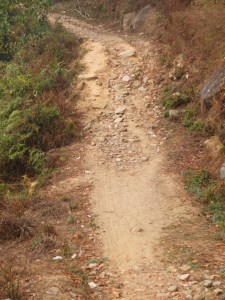 function. First, an aerial survey is carried out by helicopter, to get a general idea of possible routes. Next, engineers use Google Earth to rough out a route on a computer map. Then a team of four engineers, each representing a different key discipline (geotechnology, hydrology, etc.) goes out and walks the route to give the first real test of the route and to refine it. I can barely imagine how grueling that must be! Then it’s back to the office to create drawings and map it out in more detail. Then another set of engineers revisits the route, on the ground, to look for specific problems: cultural or natural resources that have to be avoided, springs, areas at risk of landslides, etc. Then back to the office for the final layout.
Only then does the heavy equipment go out and rough in the road. At this point the roughly graded road is called a “track” – meaning not ready for regular commercial traffic like buses, trucks delivering commercial goods, and passenger vehicles. The plan is that at some point these many tracks will get improved and possibly paved to a final, somewhat smooth grade. In the meantime, they are hellish.
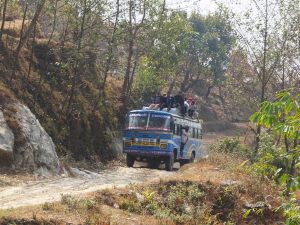
In western Gorkha, on Daraundi Danda, there is only one road on which buses are allowed, the tortured road from the valley up and north along the spine of the ridge as far as Bhachek. This is still a track, on which buses normally would not be allowed, but because of the earthquake and the need for people to be able to get in and out to carry on some semblance of normal life, buses are allowed. Other traffic is sparse, mostly 4WD tractors pulling wagons with construction materials and a fair number of jeeps and passenger/cargo vehicles similar to Land Rovers.
The other roads up on this ridge are even worse. They either branch off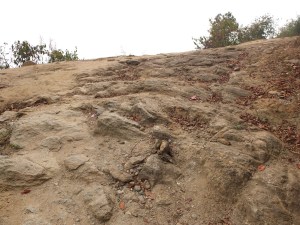 the Bhachek road to reach villages down off the ridge, or they come up side ridges from the valley of the Daraundi on the east. No bus could possibly go on these rough roads. At this point they are used almost exclusively by tractors bringing in construction materials. Except for the photos showing buses, all of the track photos here were taken on side tracks, not on the Bhachek road.
What is the future of these roads? Will they be improved beyond “track” status, maybe even paved some day? Sad to say, I have my doubts.
 Tim in Nepal
Tim, this is a very moving account of the necessity of roads and of the human cultural changes they bring. You write wonderfully .. vividly. The pictures are amazing.
Elaine
LikeLike