
Gorkha is one of Nepal’s more than 70 districts. If you went out to the big Kolanki bus park, where the Ring Road around Kathmandu meets the road to Pokhara, you could catch a bus heading west, toward Pokhara. This road is really the only east-west road through the middle hills of Nepal, for the simple reason that all the big ridges and the river systems that define them run north-south. The Pokhara road is an exception in that it manages to find its way west from the Kathmandu Valley to the Pokhara Valley.

If you caught a bus at 7:00 AM you would reach Abu Khareini, about two thirds of the way to Pokhara, by noon. At this point the Gorkha road heads north and is the feeder for most of the roads in Gorkha . If you caught the bus to Gorkha Bazaar, but got off at Bahra Kilo (“twelve kilometers”), you could catch another bus to Bhachek, high on a ridge that trends north to the big mountains. This ridge is bounded on east and west by two rivers that flow south out of the Himalaya, the Daraundi Khola on the east and the Chepe Khola on the west.
Once you leave Bahra Kilo, say goodbye to the comfort of paved roads and enter another world. You might not think the bus ride from Kathmandu to Bahra Kilo was comfortable until you start up the hill toward Bhachek.

Daranundi Danda (“ridge”) starts, at its lower and southern terminus, at an elevation of about 3500 feet and climbs north up through little villages to Bhachek – the end of the bus road – and then continues all the way up, up, up in one long, unbroken climb to the summit of Manaslu, the world’s eighth tallest mountain at almost 27,000 feet. This is a dramatic landscape.
Daraundi Danda was the epicenter of the April 2015 earthquake that leveled so many of the villages in Gorkha District and made life in the others tenuous indeed. The poster child for Gorkha devastation was the village of Barpak, far up the valley of the Daraundi Khola. While Barpak was a relatively prosperous village, home to many retired Gurkha soldiers and the beneficiary of their generous pensions, most of the other villages on this ridge were very poor before the quake and a picture of destitution today.
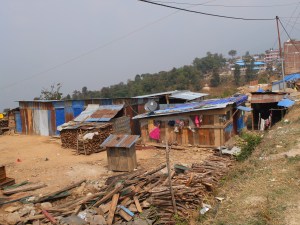
Fortunately, the earthquake struck on a Saturday during the daytime, when people were out of their houses and schools were not in session – if not for this, the death rate would have been staggering. But the schools were not spared. About 500 schools in this district were lost, most reduced to complete rubble. This is the reason why the Gorkha Foundation has chosen to put its resources into building new, better, earthquake resistant schools to replace those that were lost. It will take time and it will take money. The Foundation is not alone in this ambitious effort to bring back functional public education in western Gorkha. Other NGOs and the Nepal government are hard at work as well.
The Gorkha Foundation is justifiably proud that it designed and built the first model earthquake resistant school in response to this great need. The Nepane school now serves as an example of how to build back better, far better, than before.
If you would like to help in this effort please go to the Foundation website, http://GorkhaFoundation.org, and make a donation. The kids of Gorkha will thank you.
 Tim in Nepal
This is a very moving record and beautifully photographed. The landscape is extraordinary, and the efforts of the foundation as well.
LikeLike