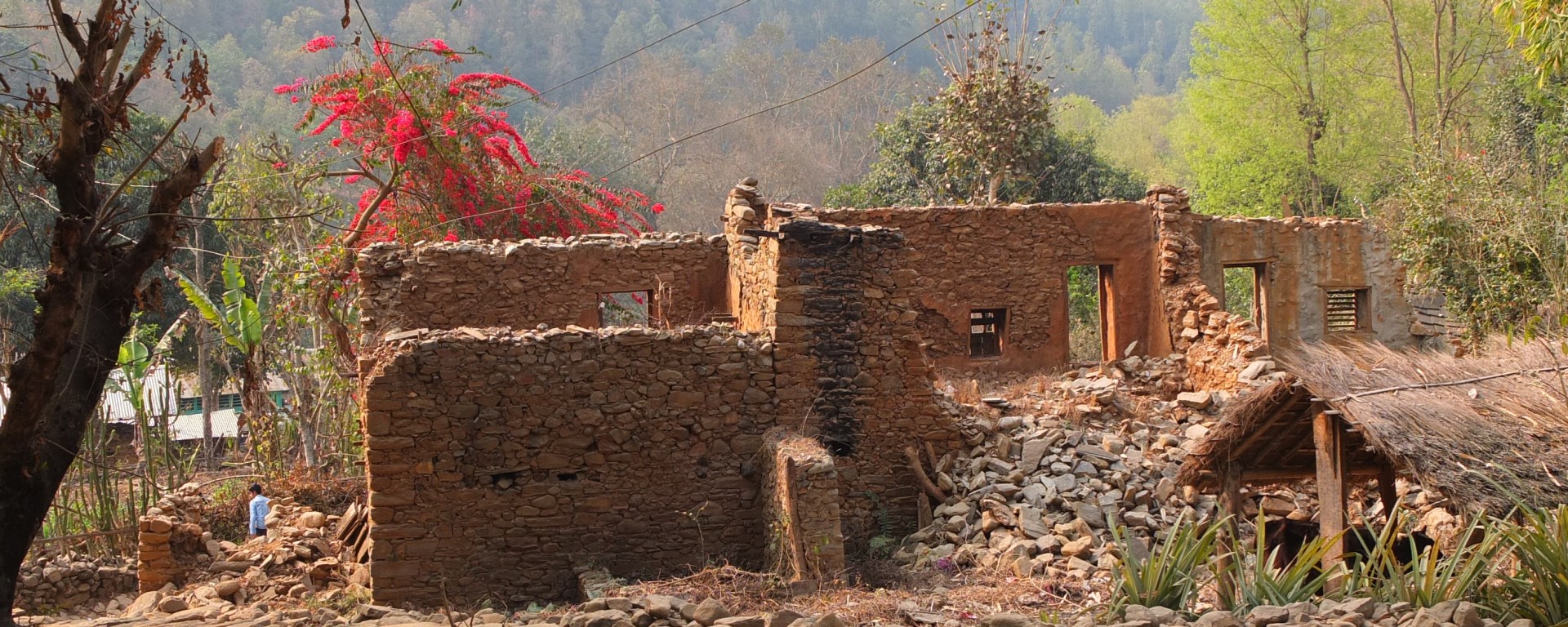
In previous posts I have focused on reconstruction of schools – my reason for coming to Gorkha. In this post I want to focus on houses: what they were like before the earthquake, how they fared as a result of the quake and how new houses are being built (or not).
The traditional house in the middle hills of Nepal was built completely of native materials. Shallow foundations were built of stone set on the ground or in shallow excavations – basically sitting on the ground rather than built into the ground. Thick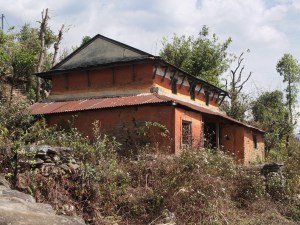 walls were built of stone loosely mortared with mud and mudded inside and out to serve as a plaster-like finish. Upper floors were again mud and stone, supported by wood or bamboo joists. These same materials were used to frame the roof structure. Actual roofing was either thatch or stone shingles. Doors and windows were hand-crafted from local wood, hand-sawn, chiseled and mortised.
This style of house was relatively easy to build and needed no hard-to-get materials or specialized hired labor from outside the village. These houses were heavy and relatively 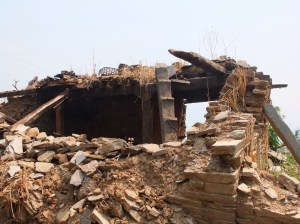 stable, held in place by gravity and weight – until they are shaken hard, say by a 7.8 magnitude earthquake. The lateral forces of a big earthquake can move a house sideways off its unstable foundation and the walls do not have any cohesion to keep them from collapsing when shaken. Worst of all if there is a heavy stone roof.

Slate roofs in some parts of Nepal are like those of Europe and North America. These roofs use relatively thin slate, each one punched or drilled with two holes at the top, and supported or “hung” by nails that prevent the slates from sliding down. We put such a roof on our house, hanging the slates from copper nails. But in most of Gorkha the slates are much thicker and much heavier. Each slate is not “hung” but instead stays in place just from the weight of the overlapping stones above. This works beautifully and could last over a hundred years – unless there is a big earthquake. The shaking of the quake dislodges the slates and tons of stone comes crashing down, destroying everything underneath. In a major quake these roofs are killers – anyone inside the house will not survive.

The effect of the 2015 earthquake in Gorkha varied from place to place. Some villages were reduced to rubble, with once beautiful native architecture now just piles of stone, mud and wood. In other places some houses were destroyed while neighboring houses might have been spared.

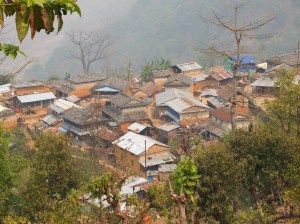
Perhaps the most difficult situations are those in which all the houses were structurally damaged but still standing. These houses may look fine from a distance, but when you get up close you see cracks in the walls, at window and door frames, in the joints between walls and ceilings, and often in collapsed gable end walls at roof level. These houses are effectively condemned. People do not dare to sleep in them for fear that the next big quake might happen at night. It is too big a risk. A new type of temporary sleeping structure has popped up everywhere: bamboo frames, walls of roofing tin or woven mats, tin roofs. People may still be cooking in the original house, but at night they troop out to sleep in these dirt-floor sheds.
 So what next? If your house collapsed it is fairly straightforward to clear away the rubble to make a space for rebuilding – if the family’s young people have not emigrated to places with jobs. A guy I know in Bhachek had a house, now collapsed, that entirely filled his tiny houselot. Now he’s stuck with a pile of rubble and nowhere to put it if he wants to clear the space for rebuilding.
If your house is still standing but unusable you have the additional cost and difficulty of demolishing it before you can rebuild. It is sad to look at a village filled with these beautiful old – but condemned – buildings that are eventually all going to have to be torn down to make way for new houses.
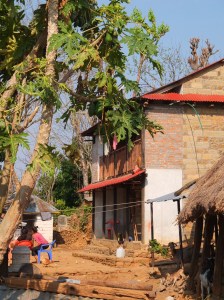
What about the money part? Everybody is waiting to see what the government will do. It has been a year since the quake, donor countries and NGOs have promised over $1 billion for reconstruction, but to date the government has not started to spend it. The current story is that each household with a house that needs to be replaced will get a 200,000 rupee grant ($2,000) provided they build according to designs approved by the government. The cost to build a house is estimated to be 1.5-2.0 million rupees, so how is that going to work for someone who doesn’t have a lot of cash at their disposal?
The current rumor is that the government is going to announce its housing grant program in April 2016, release the approved designs at the same time and and dispatch engineers to the villages and towns of the earthquake zone to train local people how to build the next generation of houses. The grants are supposed to follow shortly.
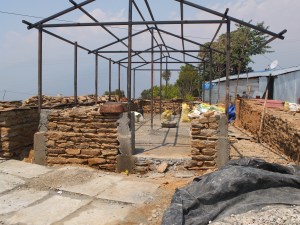
What will villages look like after reconstruction? No more stone roofs. No more thatched roofs because, it is said, pesticides have killed off the grasses from which thatch comes and the the thatch artisans are dying off. So that leaves corrugated metal roofs. Foundations will be trenched down 2-3 feet and the stone will, in many cases, be mortared with cement. Exterior walls will be at least partly mortared stone, with cement plaster finish. Above the level of the window sills, the roof structure will in most cases use site-welded steel trusses.

The traditional look of village Nepal in these hill areas will be gone forever. People will have more stable, durable houses, but these houses may be prohibitively expensive for poor people because of the necessity to use non-local construction materials. Many people will continue to it live in temporary shelters made of tin roofing and plastic tarps for decades. Life will go on.
[More photos to be added later]
 Tim in Nepal