
A fter the earthquake struck last April, with the epicenter in western Gorkha District, most of the schools in the district collapsed. Most were constructed with walls of stone and mud mortar, and many had exceptionally heavy slate roofs. To keep public school education alive these buildings were replaced with hastily constructed Temporary Learning Centers (TLs), the subject of an earlier post.
Gorkha continues to be at risk for more quakes. A week ago we felt the 425th “significant aftershock” (magnitude 4.0 or greater) since the original 7.8 quake, and my first night in Gorkha a month ago I was awakened by a magnitude 5.5 shock just before midnight. Clearly a new kind of school had to be designed and built to hold up to future earthquakes.
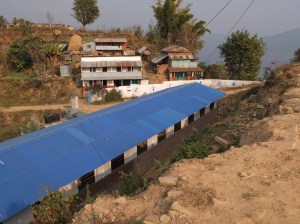
The Gorkha Foundation designed the first of this new generation of earthquake proof schools for the town of Nepane, about 15 miles west of the 2015 quake epicenter. The Gorkha Foundation model school  design was the first to be approved by the Nepal Department of Education and the first to be built. It was completed last fall, seven months after the first quake.
The Nepane model school design has these features:
- Each building is one story high, with all classrooms opening off a veranda on one side
- Deep rubble stone footings, mortared with cement
- Floor level raised one foot above grade to prevent water intrusion
- Cement-mortared stone foundation and walls up to 3 feet above floor level
- Steel lath and plaster on the masonry walls inside and out
- Aluminum frame sliding windows for ventilation
- Walls above the stone level of translucent fiberglass
- Steel truss roof system
- Ceiling panels fixed to bottom of trusses to control summer heat
- Corrugated metal roofing
- Smooth, mortared concrete-on-stone floor finish
The main bulk materials – stone, aggregate and sand – are local. Steel and cement are manufactured in Nepal. Windows and doors are fabricated in Nepal, while the fiberglass wall sheeting comes from Thailand. Roof trusses are fabricated on site by local workers. The Foundation is now re-assessing all its materials to make sure they meet the highest performance standards against a number of criteria.
While the primary design criteria are to provide exceptional stability against earthquakes, to use local materials as much as possible and to make these schools affordable to build, perhaps the greatest benefit  comes in a vastly improved learning environment. The translucent wall panels and modern windows provide wonderful daylighting, a tremendous improvement on the dark classrooms found in most schools in Nepal. In addition these classrooms have excellent ventilation and protection against the summer overheating.
The total project cost to build a 15-room high school using this design is $60,000. The Gorkha Foundation is in continuous fund-raising mode. We have three schools starting construction now and another four that are mostly funded. We also have another two developed high school projects we plan to build as soon as funds can be found and new requests from schools come in every week. If you can help in this effort, please go to the Foundation website, http://GorkhaFoundation.org. The Donate button is at the top right of every page.
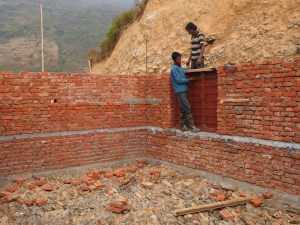
The Gorkha Foundation is not the only NGO building new schools in western Gorkha after the earthquake. While the Foundation focuses on high schools, partner OLE Nepal has raised money to build four or five elementary schools to a similar design. Some examples of schools being built by others are shown below.


 Tim in Nepal